
The New Era of Digital Stunts: Where Hollywood Meets Creator Culture
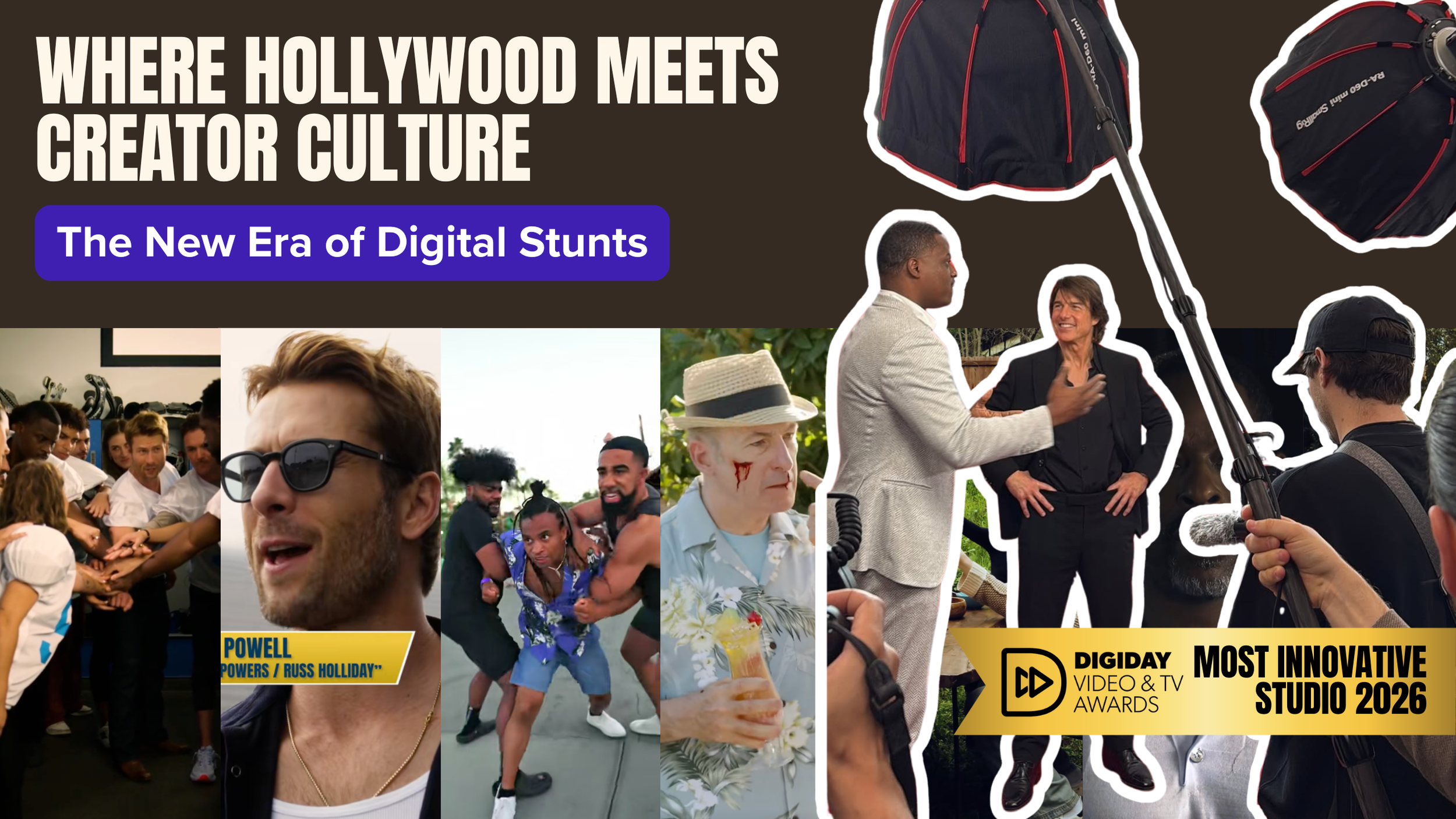
Images from Creator Campaigns promoting: Hulu’s Chad Powers, Waner Bros. Nobody 2 and Paramount’s Mission Impossible: The Final Reckoning.
By Chris Smith, VP & GM, QYOU Studios
Not long ago, social media sat on the sidelines of entertainment marketing. It was a distribution layer, a place to post trailers, extend press moments and capture incremental reach.
That’s no longer the case.
Today, social is the front line. It’s where discovery happens, where fandom forms and increasingly, where storytelling begins. In many ways, it has become the new red carpet.
At the same time, we’re seeing another major shift: the lines between Hollywood talent and creators are disappearing. Actors, studios and digital creators are no longer operating in separate lanes. They’re collaborating in ways that feel native, narrative-driven and built for the platforms where audiences actually spend time.
At QYOU, this is the space we’ve been building toward. As a social media agency operating at the intersection of creator culture and entertainment, we’ve focused on campaigns that are designed for the way audiences engage today. Last month, we were honored to be named Most Innovative Studio by Digiday, a recognition that reflects not just a body of work, but a broader shift in how influencer marketing is evolving with entertainment. Our recent campaign for Hulu’s Chad Powers is a clear example of that evolution in action.
The idea behind Chad Powers was simple: instead of promoting the show, extend it. Working closely with Hulu, we took a fictional “tryout” moment from the series and turned it into a real-world, creator-led experience. The campaign unfolded as a 10-part digital stunt, where creators stepped directly into the world of the show, participating in challenges that mirrored the narrative fans would see on screen.
What made it work was the way it blurred boundaries. The content combined structured storytelling with real reactions, giving it the feel of both a scripted series and a live experience. Glen Powell and the cast became part of the creator ecosystem, showing up in ways that felt unexpected and genuinely engaging. For audiences, it didn’t feel like marketing. It felt like the story was continuing in their feed.
That distinction matters. Audiences today are incredibly adept at filtering out traditional promotion and standard influencer ads. What they respond to instead is participation or content that invites them into the world, rather than asking them to observe it from the outside. The Chad Powers campaign tapped directly into that dynamic, generating more than 17 million views and strong engagement across platforms, but more importantly, driving conversation and curiosity around the series itself.
This approach is part of a much larger shift we’re seeing across the industry. From Mission: Impossible to Nobody 2 to Chad Powers, studios and talent are increasingly embracing what we think of as a new creative model, one where creators are not just amplifiers but collaborators. They bring their own audiences, their own voice, and their own credibility, and when that’s combined with the scale and storytelling of a studio production, the result is something far more powerful than traditional advertising.
Of course, making this work requires balance. Creators thrive on authenticity and spontaneity, while studios need consistency and alignment with the IP. The key is not to over-engineer the process. For Chad Powers, we built clear narrative guardrails but left room for creators to interpret and improvise within that world. Some leaned into scripted beats, others brought their own comedic timing or storytelling style. That flexibility is what made the content feel real and why audiences engaged with it.
This approach has been central to QYOU Studios’ work over the past year. Across campaigns for A Quiet Place: Day One, Smile 2, and Mission: Impossible – The Final Reckoning, we’ve continued to push the idea of digital stunts as a storytelling format, not just a marketing tactic. These campaigns are designed to live natively on social but with the ambition, structure and production value of entertainment. It’s a model that blends content creation services with platform-native storytelling in a way traditional campaigns often struggle to achieve.
What we’re seeing now is a clear signal about where the industry is headed. Entertainment marketing is becoming more collaborative, more narrative-driven and more integrated with the creator ecosystem. Audiences expect to engage with stories in the same spaces where they consume everything else and they expect those experiences to feel authentic to the platform.
For studios and marketers, that means thinking differently about how campaigns are built. It’s no longer enough to adapt a trailer for social. The story itself has to be designed to travel, to extend, evolve and invite participation. Stronger social media planning and creator collaboration are now central to how modern campaigns break through.
For creators and talent, it opens up entirely new creative territory. These collaborations are not about replacing one with the other but about combining strengths to create something neither could do alone.
And for audiences, it means something even more important: the chance to experience stories in a way that feels immediate, immersive, and connected to culture as it’s happening.
That’s the opportunity we’re focused on at QYOU, building campaigns that don’t just promote entertainment, but become part of it.
FAQ
What is a digital stunt?
A digital stunt is a narrative-driven, creator-led campaign designed to unfold across social platforms as entertainment, rather than traditional advertising.
Why are creators central to this approach?
Creators bring authenticity and built-in audience trust, making them ideal collaborators in extending a story’s world in ways that feel natural and engaging.
What’s the biggest takeaway for marketers?
Start with the story, not the deliverables. When creators are invited into the narrative, the campaign becomes something audiences want to follow not skip.
